Posted Friday, 9 January 2026
Scitech gets Ah! Rated for Fringe
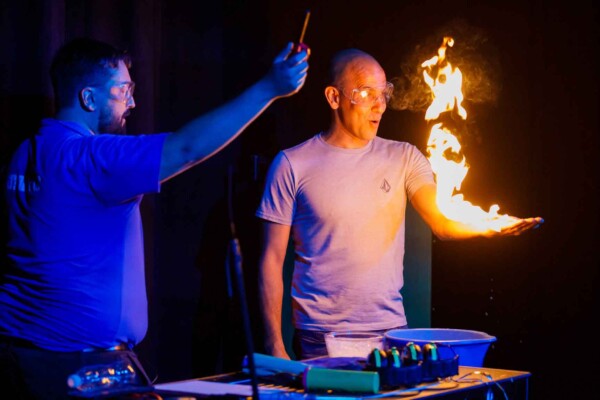
Scitech is returning to FRINGE WORLD Perth with a strictly 18+ show.

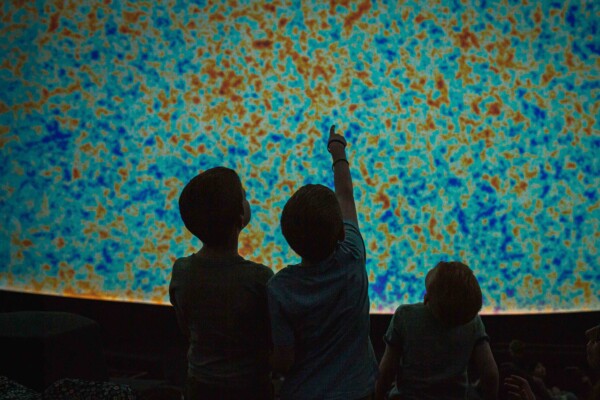
The Radio Astronomy exhibit invites visitors to learn about the incredible technology behind the world-leading radio telescopes hosted in Western Australia.

Visitors to the Scitech Discovery Centre are discovering how Western Australia is playing a key role in one of the most exciting frontiers of cosmic discovery.
The Radio Astronomy exhibit, part of Scitech’s new Here, There and Everywhere gallery, invites visitors to learn about the incredible technology behind the world-leading radio telescopes hosted in Western Australia, including the SKA Observatory’s international SKA-Low telescope.
Currently under construction, the SKA-Low telescope will be one of the world’s largest and most advanced radio telescopes, with thousands of antennas spread across the outback, pushing the boundaries of what we can learn about our Universe.
Unlike optical telescopes, radio telescopes can detect invisible signals from space, revealing details of the Universe that can’t be seen with the naked eye.
Visitors to the Radio Astronomy exhibit can experience this technology for themselves by arranging antenna stations and adjusting their own radio telescope to capture the sharpest view of cosmic phenomena.
The development of the Radio Astronomy exhibit was made possible thanks to the support of our valued partners – the SKA Observatory (SKAO), Australian Government Department of Industry, Science and Resources, the Western Australian Government Department of Energy and Economic Diversification, CSIRO – Australia’s national science agency, Wajarri Yamaji Aboriginal Corporation, International Centre for Radio Astronomy Research (ICRAR), Pawsey Supercomputing Research Centre, and the Australian SKA Regional Centre (AusSRC).
The Wajarri Yamaji are the Traditional Owners and Native Title Holders of Inyarrimanha Ilgari Bundara, the CSIRO Murchison Radio-astronomy Observatory, where the SKA-Low telescope is being built.
WA Chief Scientist Professor Sharath Sriram said Western Australia is one of the best places in the world for radio astronomy, which was reinforced during his recent visit to Inyarrimanha Ilgari Bundara.
“We have an unparalleled view of the Universe and some of the best skies for radio astronomy, and decades of investment from the Australian and WA governments means we also have world-leading radio astronomers and science facilities,” Professor Sriram said.
“Western Australians should be proud to have the international SKA-Low telescope in our backyard – the ‘next big thing’ in our quest to discover the secrets of the Universe.”
Scitech Chief Executive Officer Dr John Chappell said Here, There and Everywhere was Scitech’s biggest gallery transformation in its 37-year history.
“With 17 new exhibits, the gallery connects visitors with real-world science and technology that is shaping our lives, our communities, and our world,” Dr Chappell said.
“We are so excited to bring to life some of the incredible science happening in WA and we hope it sparks curiosity and ongoing engagement with science.”
In developing the Radio Astronomy exhibit, Scitech tested the design with the Test Pilots children’s reference group, to ensure it was optimised for engagement, fun and learning.

For more information about the new gallery, visit the Here, There and Everywhere webpage.
Scitech is a not-for-profit organisation proudly supported by the Western Australian Government through the Department of Energy and Economic Diversification




Upon clicking the "Book Now" or "Buy Gift Card" buttons a new window will open prompting contact information and payment details.