January 2026
The Sky Tonight - January 2026
January continues the season of Birak, meaning the hot weather is here to stay. The silver lining is that the night skies are …
Explore
February continues the appalling season of summer and appropriately brings us into Bunuru – ‘the second summer’. On the bright side, the hot days give way to clear nights perfect for stargazing.
The two brightest stars in the night sky, Sirius and Canopus, make for nice viewing as they are almost directly overhead on a north-south line at about 9pm during February evenings. From here you have two choices.
Option 1 is to follow Sirius to the north to find Orion and the hunting dogs, Canis Major and Canis Minor. Option 2 is to follow Canopus to the south catching a glimpse of the Magellanic Clouds (if you are far away from city lights!) and spotting the Southern Cross, which makes a spirited appearance in the southeastern skies after lurking very low on the southern horizon for the last couple of months.
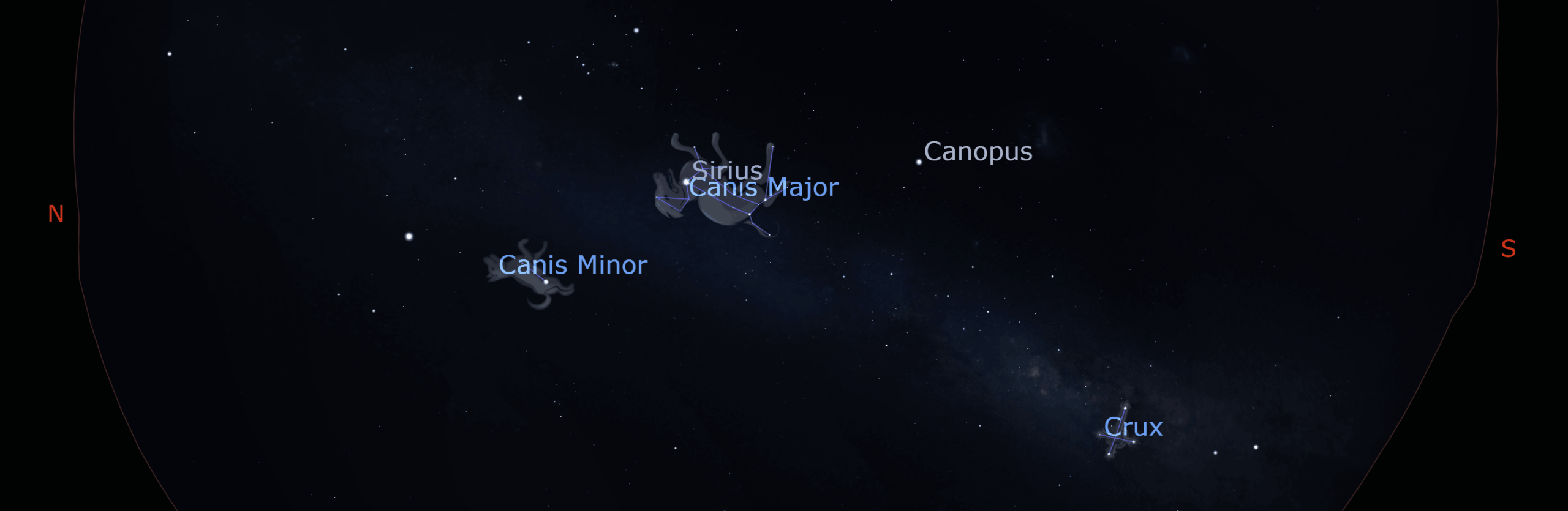
Image: The north-south line makes for a fun trail of sights during February evenings. Credit: Stellarium.
There is an Annular Solar Eclipse on Feb 17. You technically can see it from Australia in the sense that the path of maximum coverage passes over the Australian Antarctic Territory. This is not a total solar eclipse, so the Sun will never be completely blocked by the Moon no matter where you look at it from, but people at Casey Station and Davis Station will see about 90% of the Sun covered, while those at Mawson Station will see about 85% coverage. So umm, for all our Antarctic readers… send us a snapshot!
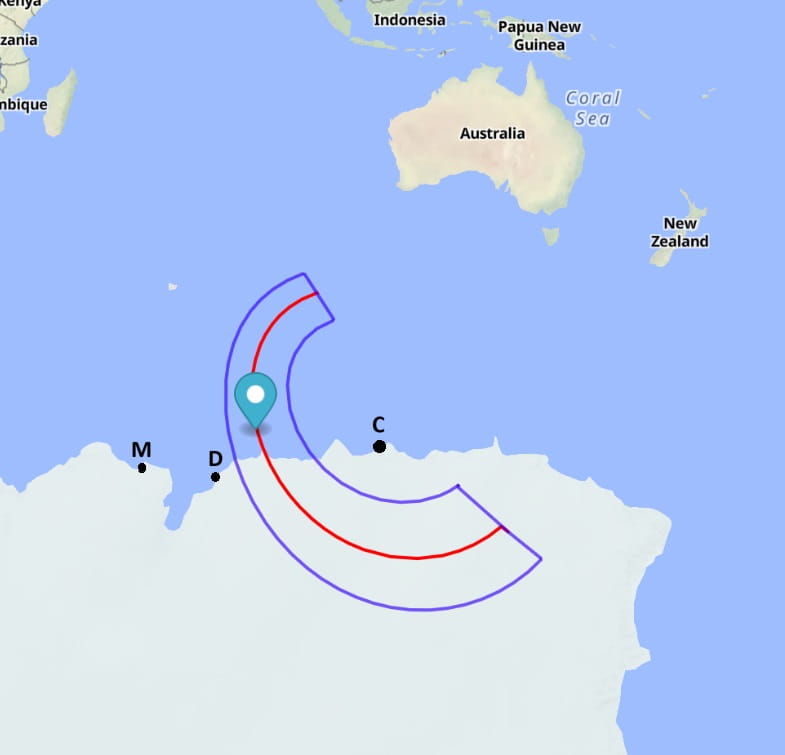
Image: The path of the eclipse on Feb 17 with Australian Antarctic research stations labelled. Credit: Eclipse Predictions by Fred Espenak, NASA/GSFC Emeritus. Markup by Smith/Scitech.
This is an annular eclipse, meaning that the Moon doesn’t quite cover the Sun in totality, like it did in Exmouth a few years ago. Because the orbit of the Moon is oval shaped, not a perfect circle, its distance to the Earth changes depending on where it is on its orbit. If an eclipse occurs when the Moon is on the more distant parts of its orbit (meaning it looks smaller in the sky) it doesn’t cover enough of the sky to block out the Sun completely. This means that even in the best possible spot, the Sun still ‘peeks around’ the Moon on all sides, making a ring (or annulus) of sunlight in the sky, giving these eclipses their name.
Speaking of the Moon, Artemis II might launch in February to return humans to the Moon. See the feature article below for more information.
There are several good opportunities to see the International Space Station during February.
The International Space Station passes overhead multiple times a day. Most of these passes are too faint to see but a couple of notable sightings* are:
| Date, time | Appears | Max Height | Disappears | Magnitude | Duration |
| 5 Feb 8:43 PM | 10° above NW | 67° | 10° above SE | -3.5 | 6.5 min |
| 6 Feb 4:50 AM | 10° above WSW | 48° | 10° above NNE | -3.5 | 6 min |
| 6 Feb 7:52 PM | 10° above NNW | 55° | 10° above SE | -3.7 | 6.5 |
| 7 Feb 4:04 AM | 46° above SW | 81° | 10° above NE | -3.7 | 4 min |
Table: Times and dates to spot the ISS from Perth
*Note: These predictions are only accurate a few days in advance. Check the sources linked for more precise predictions on the day of your observations.
Source: Heavens above, Spot the Station
Potential launch of Artemis II
February 7
Annular Solar Eclipse
February 17
Moon underneath Orion
February 26
Moon close to Jupiter
February 27
Once again, there is only one planet worth looking at this month, and fittingly it is the king of them all, Jupiter. You can see Jupiter in the northeast as the Sun sets as an unmissable whitish bright looming object sitting above the noticeable stars of Castor and Pollux. It will move across the northern sky over the course of the evening and set in the west about 4am.
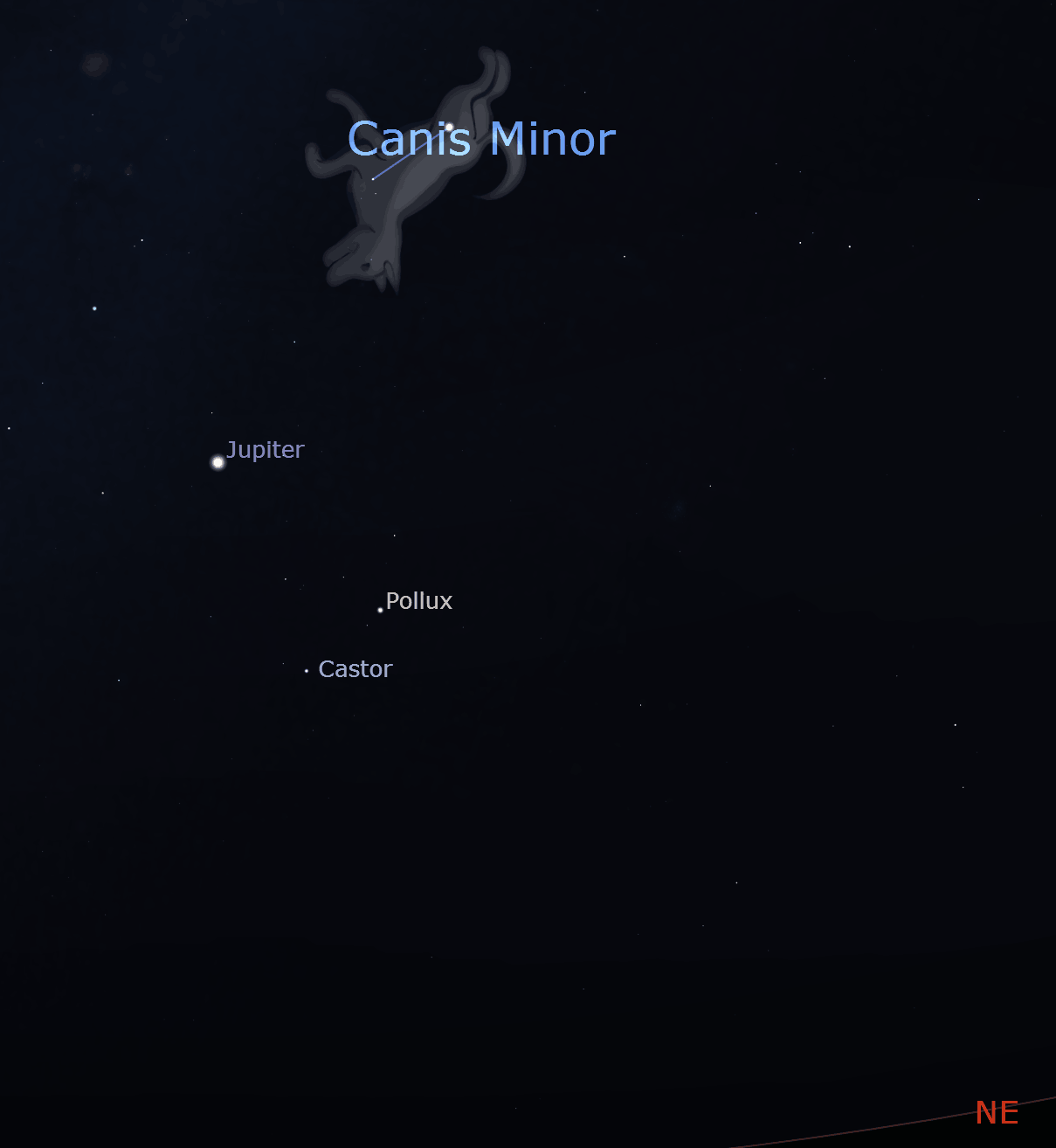
Image: Jupiter in the northeast during February evenings sitting underneath Canis Minor. Credit: Stellarium
Saturn is visible in the northwestern sky from sunset until it sets about 8:30pm. Sure, it’s there, but you’ll have to wait for later in the year for better views of it.
Mercury, Venus and Mars are largely lost in the glare of the Sun this month.
Canis Minor is a small constellation in the northern sky visible in the northeast during February evenings. It is famously one of Orion’s two hunting dogs and is dominated by its two brightest stars, the magnitude 0.34 Procyon, and the magnitude 2.9 Gomeisa.
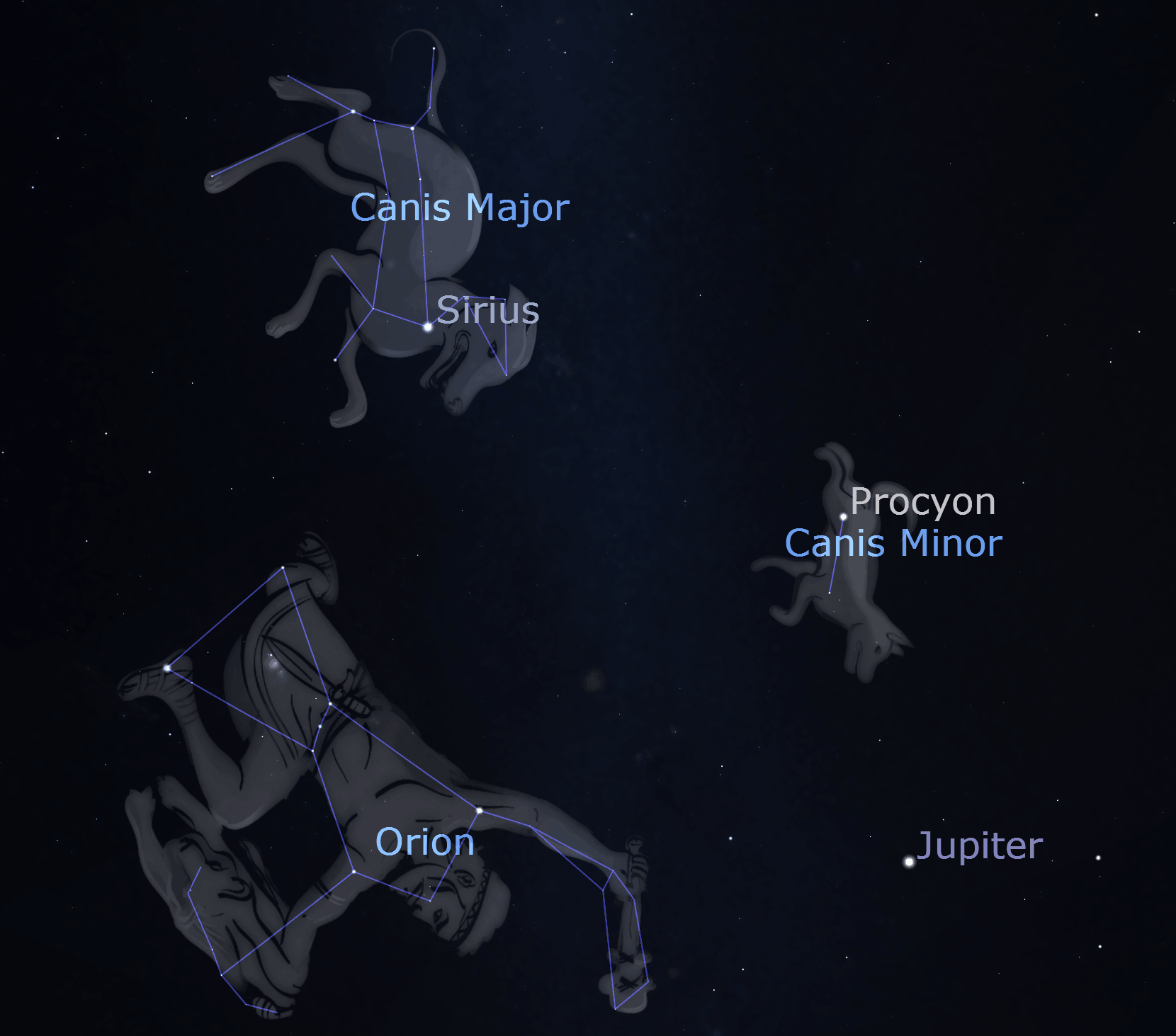
Image: Canis Minor, Canis Major, Orion and Jupiter as seen on February 14. Credit: Stellarium
Procyon translates from ancient Greek as ‘before the dog’ (pro = before, cyon/kyon = dog). Because of their relative positions in the sky, when viewed from anywhere above about 30°N, Procyon rises in the east before its more famous sibling Sirius. Sirius is well known as the ‘dog star’, and the name for Procyon follows. Interestingly, as viewed from anywhere in Australia, it actually rises after Sirius because of our far southern latitudes changing the viewing angle. Perhaps in Australia we should call it Metacyon.
If you’re watching the night sky from Casey Station in Antarctica, fresh off the excitement of a partial solar eclipse on Feb 17, then when the Sun sets at about midnight you’ll be able to see Procyon and Sirius low in the northwestern sky for about two hours until the Sun rises again.
The main lesson from Canis Minor is the same as Telescopium, from November last year, which is that the pictures shown in constellations aren’t real. Astronomers define constellations to be the region of the sky containing the stars, not the pattern of stars themselves. Drawing a dog in there and telling stories about it is a bit of fun for the backyard stargazer, and at the same time the professional astronomer can easily guide their colleagues to objects of interest by naming the unique region of sky that they’re looking at.
Sometime in the next couple of months, NASA will be launching Artemis II to get humans close to the Moon for the first time in almost 54 years. If all goes well, the Space Launch System (SLS) will hurl the Orion spacecraft and 4 astronauts into an orbit around the Moon and back. The crew will conduct hundreds of tests of the Orion spacecraft and launch system, test communication systems, observe the deep space environment, perform medical testing, and of course, observe the Moon in great detail.
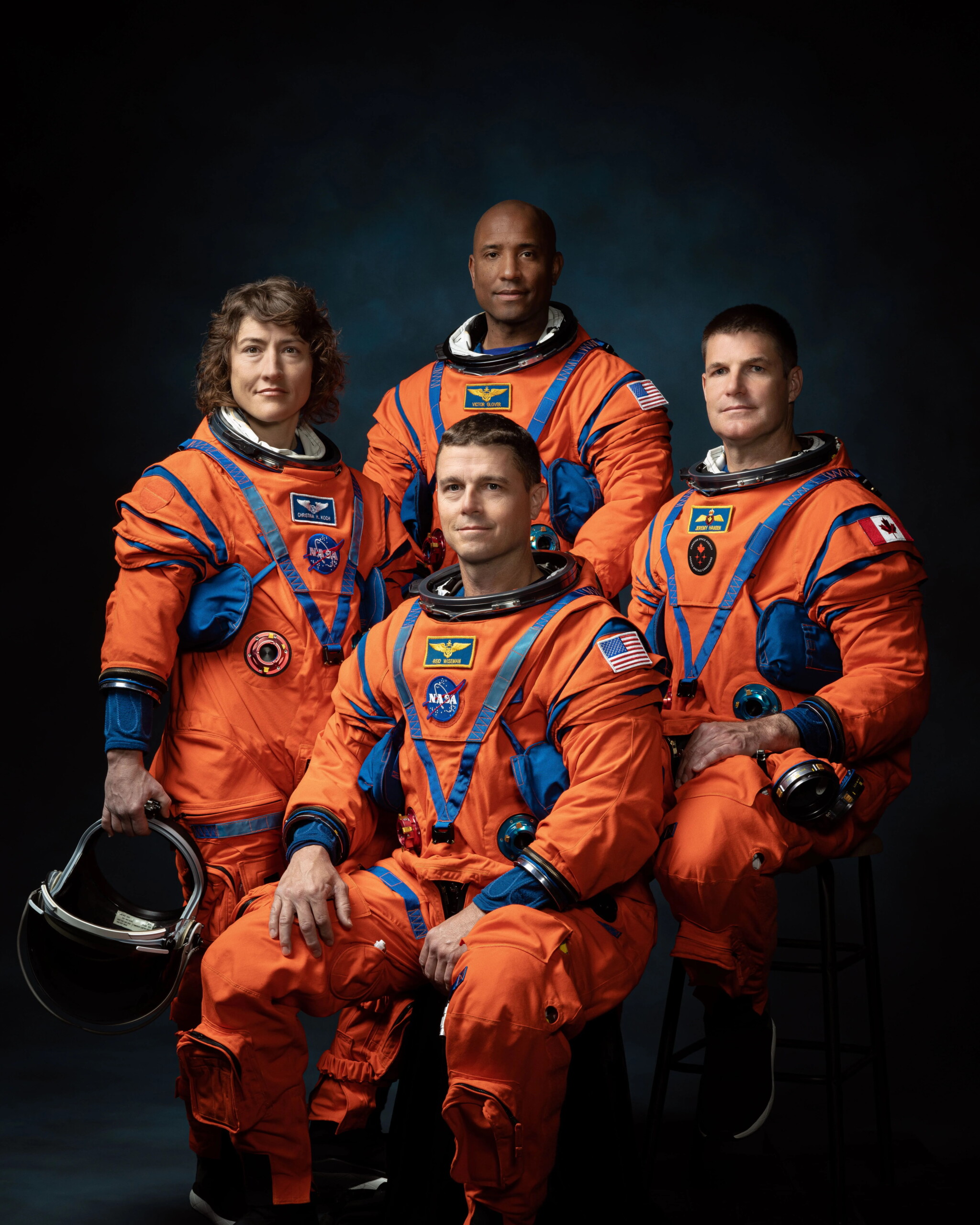
Image: The crew of Artemis II, clockwise from the front: Reid Wiseman – Commander, Christina Koch – Mission Specialist, Victor Glover – Pilot, Jeremy Hansen – Mission Specialist. Interestingly, for Canadian Astronaut Jeremy Hansen, this is his first spaceflight. A hell of a way to make an entrance. Credit: NASA
Because the Moon and Earth are always moving, there are better times than others to launch a spaceship there, called launch windows, so it’s impossible right now to say exactly when they will light the candle, but it will be soon.
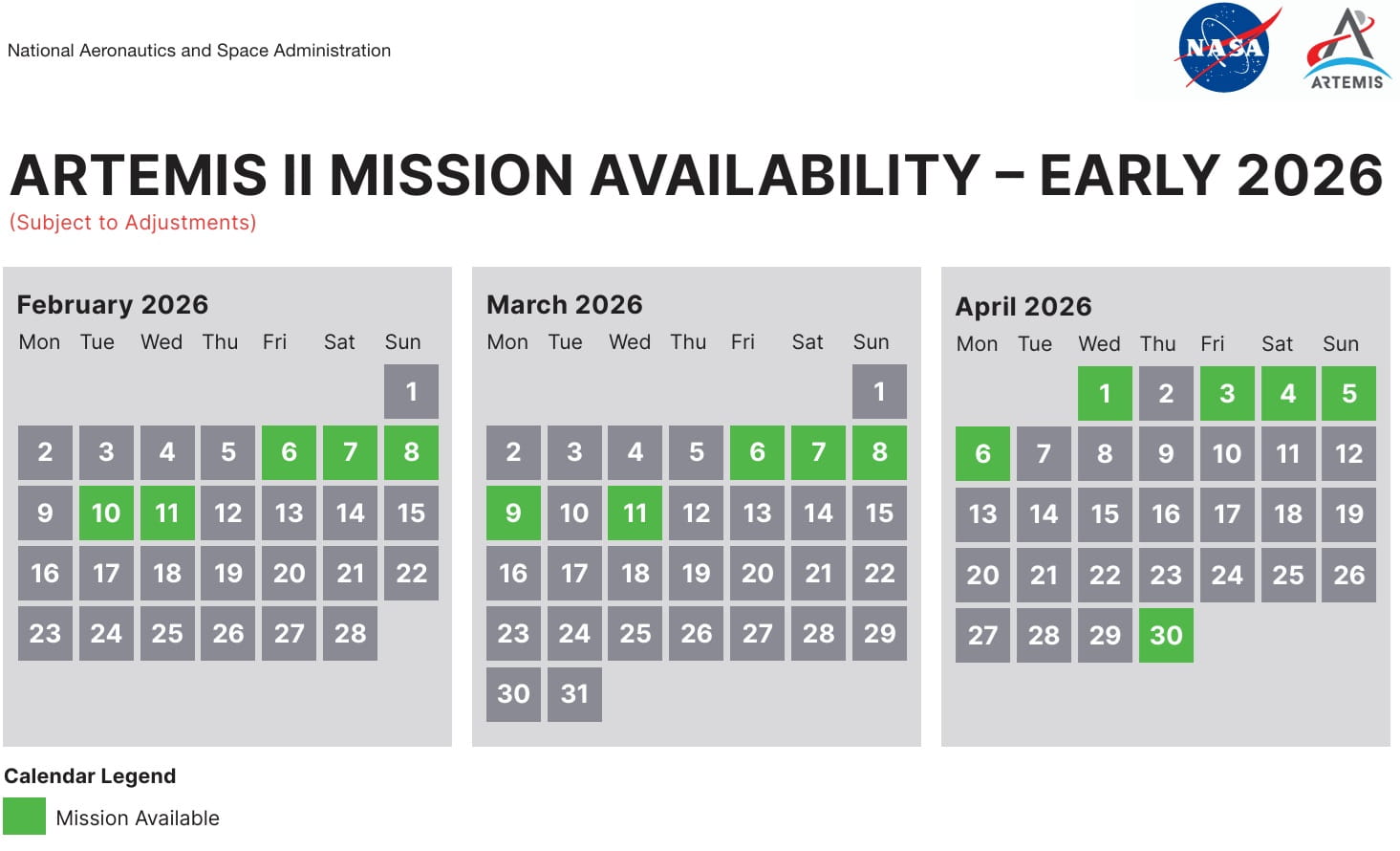
Image: Potential launch dates of Artemis 2 (dated for US Eastern Standard Time). Credit: NASA
After liftoff, the astronauts will spend a couple of days in an intermediate orbit, taking them about a fifth of the way to the Moon, during which they will verify that everything is working properly, test communications with Earth and get some flight experience, before continuing all the way to the Moon. The free return trajectory they will take to the Moon is designed to minimise the difficulty of getting back to Earth safely if anything goes wrong.
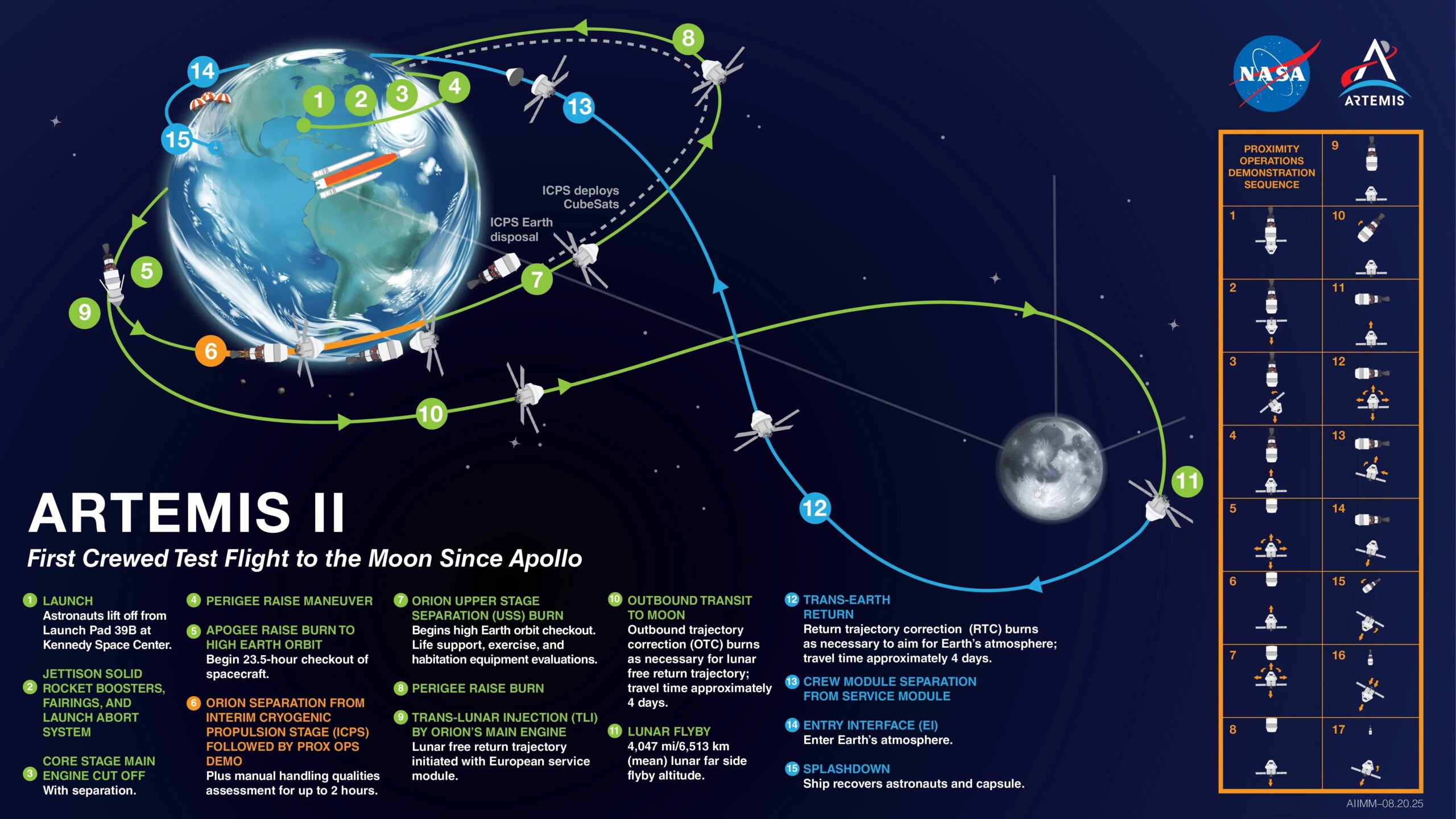
Image: Flightpath of Artemis II in a Moon centred point of view. It’s literally rocket science. Credit: NASA
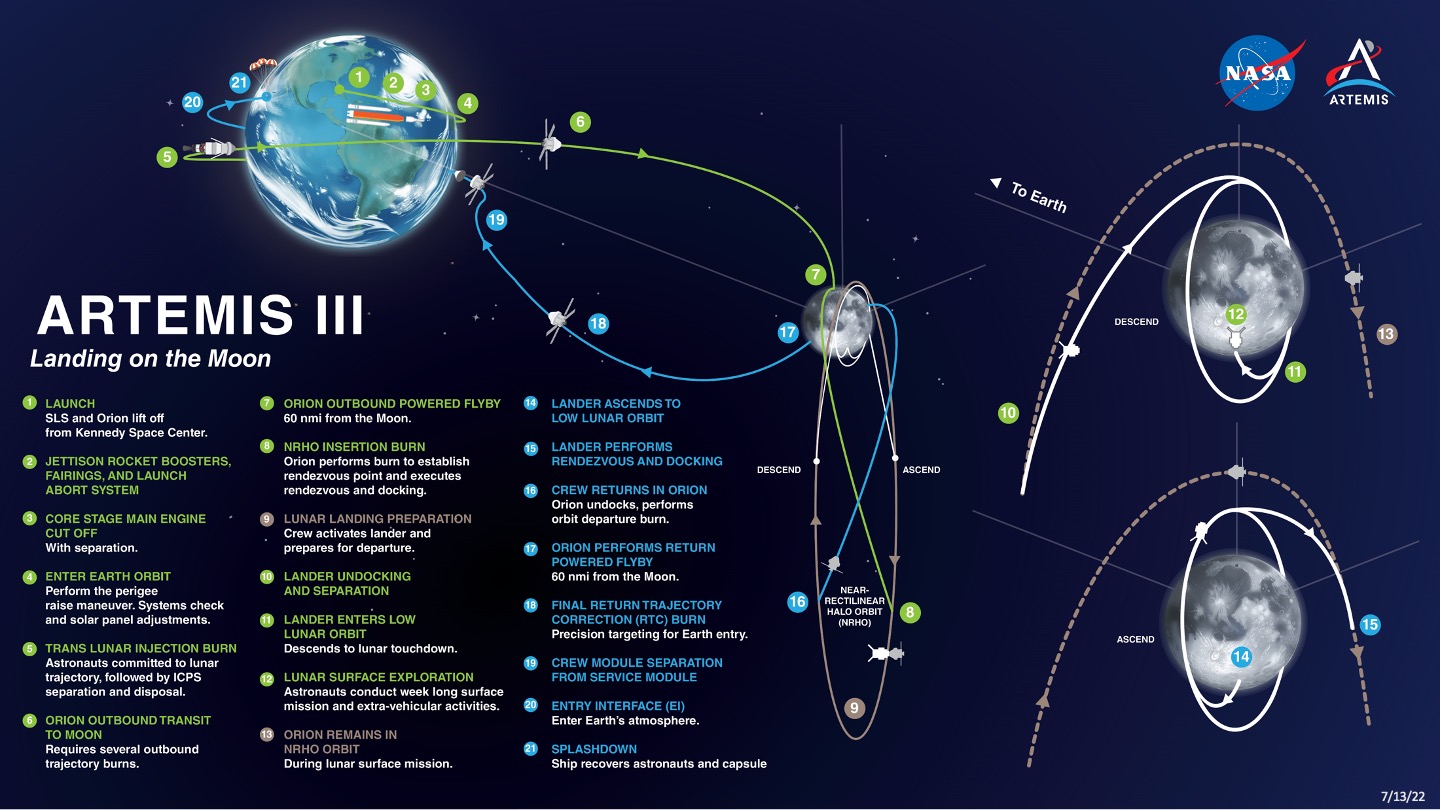
The Artemis Program is NASA’s flagship Moon exploration project and consists of a series of increasingly ambitious missions to our natural satellite. Artemis I launched in Nov 2022 sending an uncrewed Orion spacecraft around the Moon and back. Artemis II largely repeats the mission, this time with people aboard. They won’t land on the Moon – that will happen during Artemis III, still in the planning stage.
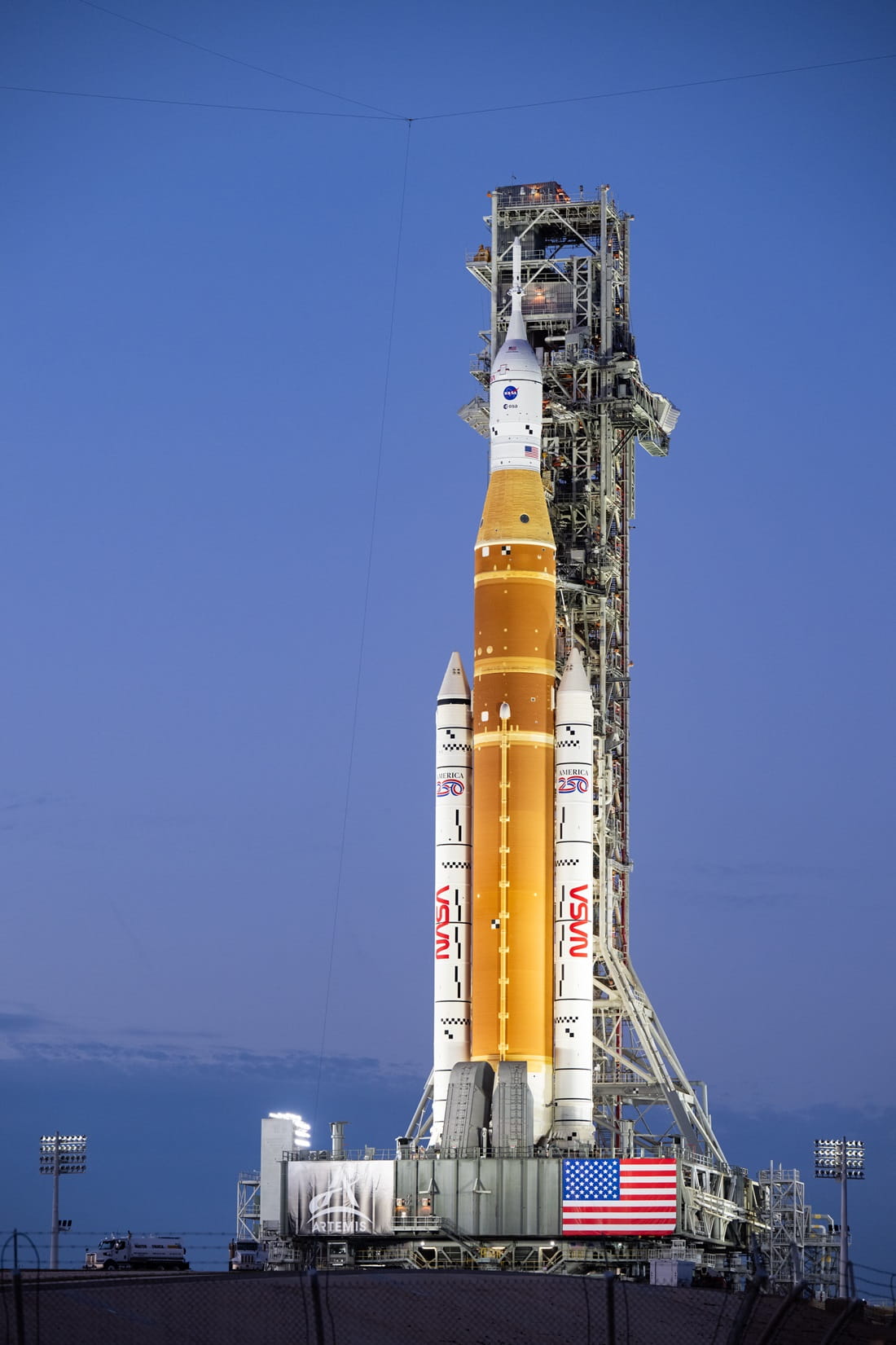
Image: The SLS for Artemis II rolled out to the launch pad on Jan 17. Credit: NASA/Keegan Barber
The heart of the Artemis Program is the enormous Space Launch System; a rocket made from repurposed Space Shuttle technology. At its inaugural launch in the Artemis I mission it was, at the time, the most powerful rocket ever flown. Unfortunately, the delayed and expensive development of the SLS, severely straining relationships between NASA and prime manufacturer Boeing, have pushed the price tag out to about $4 billion AUD per vehicle.
This is where the Artemis Program presents a complex topic for spaceflight enthusiasts. The tremendous cost of launch makes the program unsustainable, so any flights on the SLS will be more symbolic than genuinely long-term, and certainly not scalable. But also, there is literally no alternative right now.
If SpaceX can perfect Starship as a lunar lander (big if), planned for Artemis III, then that will place everybody’s favourite Xitter owner in a powerful position to monopolise the situation and pursue commercial opportunities when the SLS is inevitably deemed unsustainable. Meanwhile China is certainly not lagging behind, with an aggressive program to develop its heavy spaceflight capability.
But no matter how you look at it, the 21st century space race is well underway. One way or another, people will set foot on the Moon again soon.
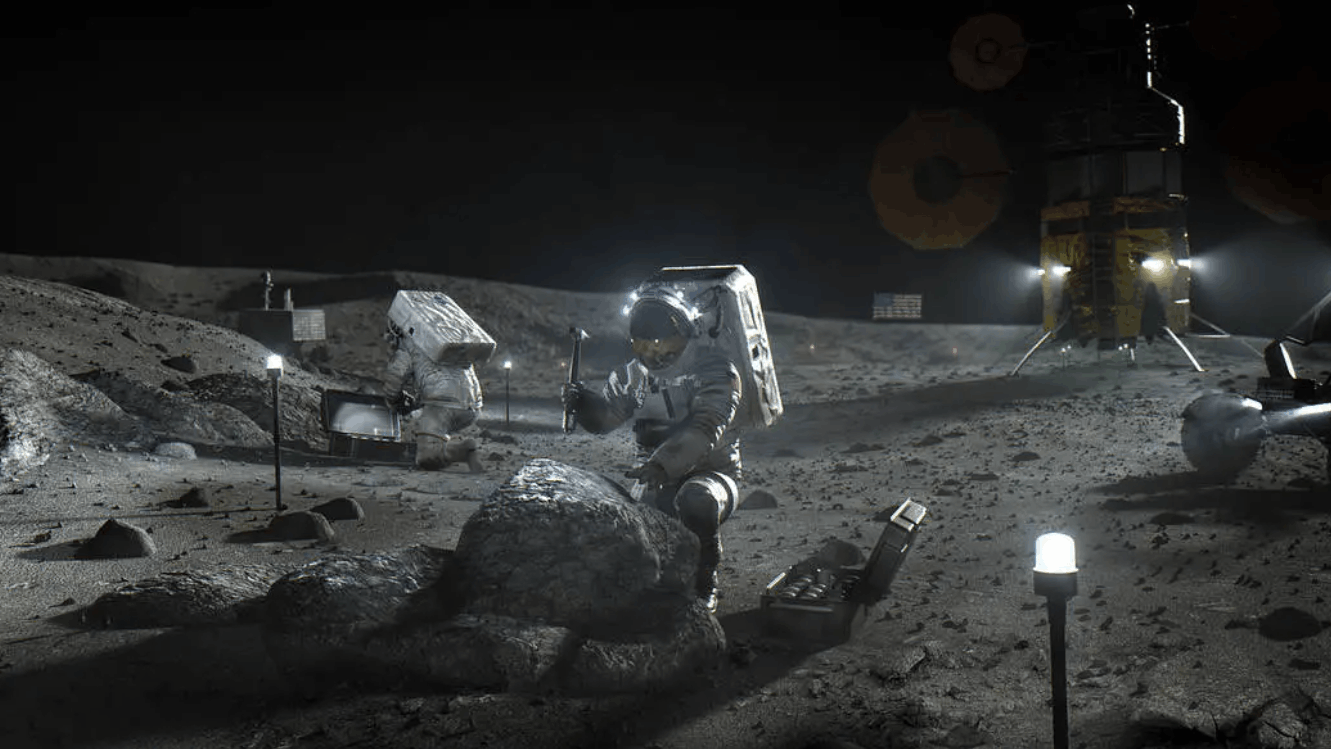
Image: Artist impression of astronauts returning to the Moon. Credit: NASA
Realistically, no attentive space observer truly thinks that Artemis II will be getting off the ground in February. NASA has (these days) put tremendous effort into minimising risk and will take no shortage of time and effort to verify that all systems are ‘go’ before pressing the big launch button. But never say never.
Raise your hopes, but not your heart rate. This will happen, but don’t be surprised if it gets delayed. In the Scitech Planetarium we have a wager going for when it will take off. My money is on March 11.
And it will be very exciting when it does.
Scitech is a not-for-profit organisation proudly supported by the Western Australian Government through the Department of Energy and Economic Diversification




Upon clicking the "Book Now" or "Buy Gift Card" buttons a new window will open prompting contact information and payment details.