February 2026
The Sky Tonight - February 2026
February continues the appalling season of summer and appropriately brings us into Bunuru – ‘the second summer’. On the …
Explore
January continues the season of Birak, meaning the hot weather is here to stay. The silver lining is that the night skies are clear and good for stargazing.
The eastern sky delights us during January evenings with the “Orion group” of constellations nicely visible. See the hunter accompanied by the dogs Canis Major and Canis Minor confront the mighty bull Taurus. For some reason there’s also a unicorn in there, just to keep things real.

Image: The eastern sky at 9pm during January is full of easy to recognise constellations. Credit: Stellarium.
Jupiter also joins the party in the eastern sky during January evenings. You can find it just under Canis Minor in the constellation of Gemini. The mightiest of planets reaches opposition on Jan 10, meaning it is exactly opposite the Sun in the sky. If you point one hand at the Sun and the other at Jupiter you will be pointing in opposite directions. This means that Jupiter rises in the east at the exact same time as the Sun sets in the west, and is visible all night.
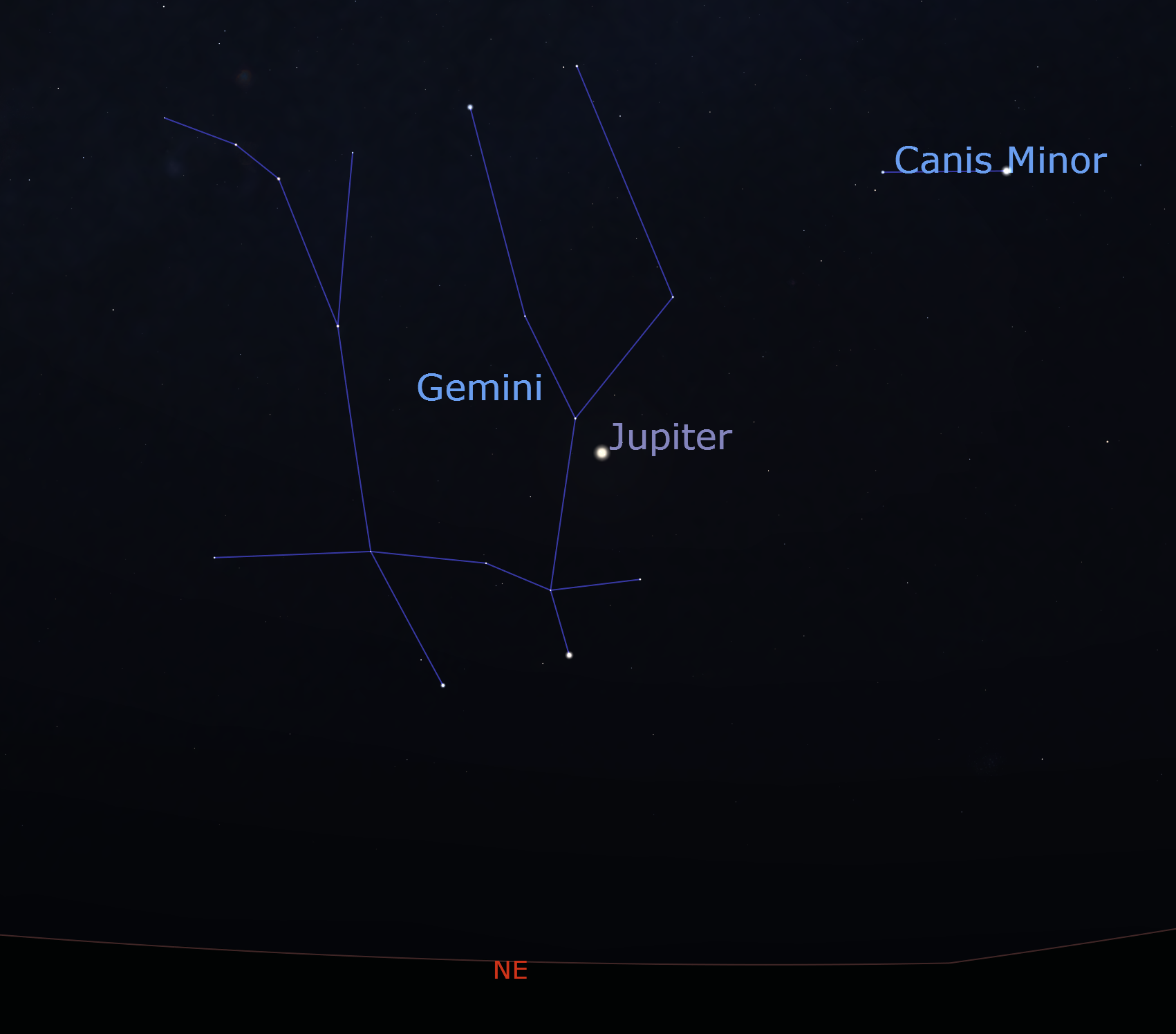
Image: Jupiter’s location in the sky during January. Credit: Stellarium.
Earth reaches perihelion on Jan 4, the point on its orbit where we are closest to the Sun. This happens because Earth’s orbit around the Sun is not quite perfectly circular, meaning that the distance to the Sun changes over the year. This places us at a minimum distance (perihelion) of 147 million km during January and a maximum distance (aphelion) of 152 million km during June, and back again over the course of a year.
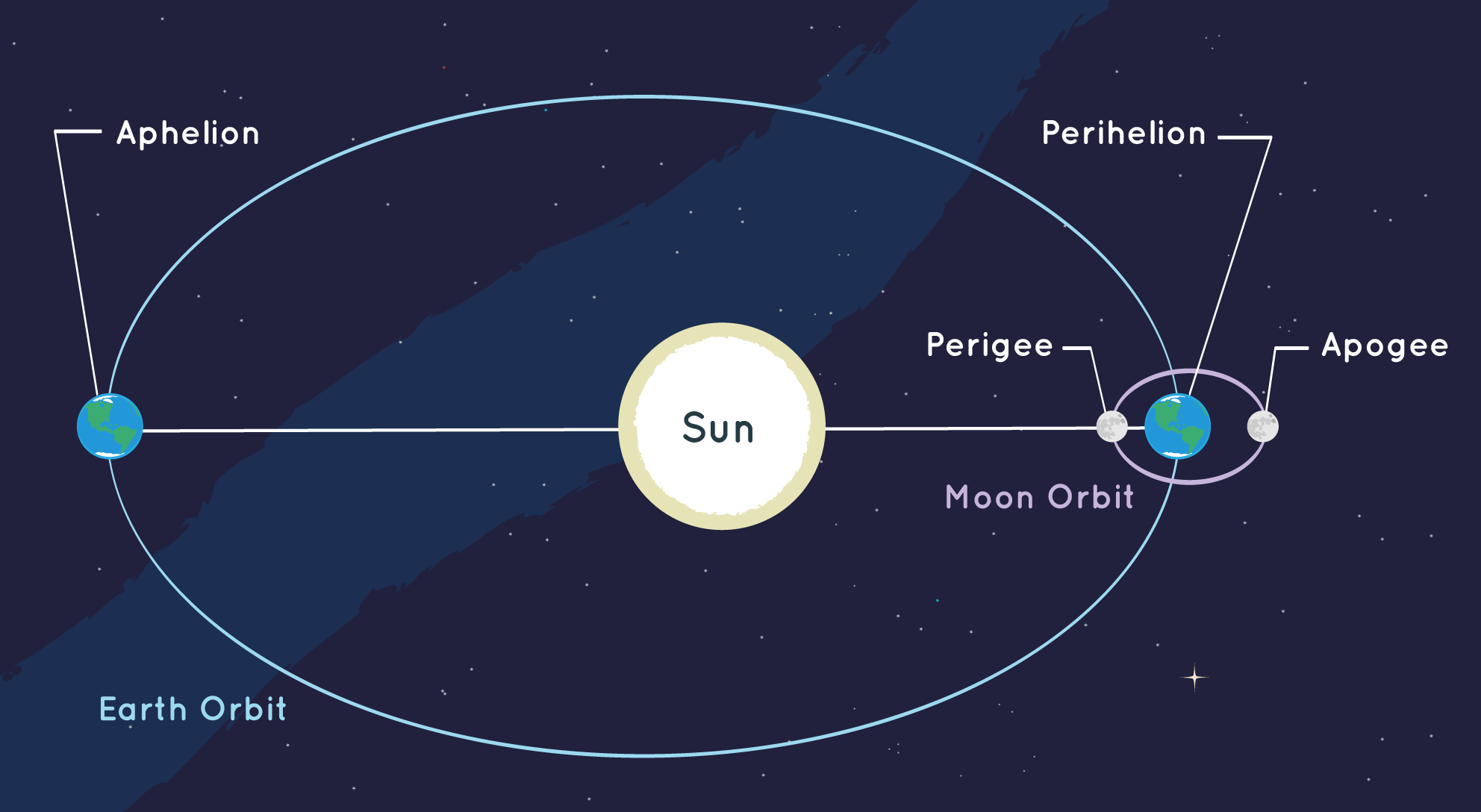
Image: Visualising the perihelion and aphelion, exaggerated for clarity. Credit: NOAA
It is time for a handy reminder that Earth’s distance from the Sun is not what causes our seasons (remember, it’s winter up north right now!). While it is certainly true that Earth’s variable distance to the Sun does have an effect on temperature, on the scale of Earth’s almost-perfectly-circular orbit, the result is only a few degrees. Earth’s tilted rotation axis, which is currently pointing the southern hemisphere towards the Sun (and the northern hemisphere away from the Sun) has a much greater effect on temperature, and is the real reason for the seasons.
Moon close to Jupiter
January 3
Earth at perihelion
January 4
Jupiter at opposition
January 10
This is a rare month where there is only one planet worth looking at: Jupiter. It dominates the eastern sky during January evenings, so make sure you take the chance to see it. Saturn is visible as a yellowish dot in the northwestern sky during the evenings but is rapidly being left behind by Earth and is setting by 9:30pm by the end of the Month.
What other planets can I easily see in the sky this month? Take it away Nathan Explosion:
Video: An eloquent discussion of the easy viewing targets in the planet classification during January 2026. Credit: Adult Swim, Metalocalypse
Musca is a small, faint constellation in the southern skies located directly ‘underneath’ the Southern Cross and is usually interpreted as a fly.

Image: Musca and the Southern Cross. Credit: Stellarium
Musca is home to several stars from the Scorpius-Centaurus Association – a loosely bound cluster of stars spreading across the galaxy. Most of the brightest stars you see in Musca are likely members of this group.
Notably, many stars in the association are of type O or B – extremely hot and bright stars powered by furious consumption of their nuclear fuel. They typically shine with surface temperatures more than 30 000 degrees Celsius, about five times hotter than the surface of the Sun.
Because they burn so furiously, these types of stars don’t live very long. The fact that we can see them at all means they are very young, cosmologically speaking, and astronomers estimate they are only several million years old. If you wrap Earth’s history into a single 24-hour day, dinosaurs appeared at 10:45pm in the evening and (mostly) disappeared at 11:40pm. These stars appeared at 5 minutes to midnight.
Point a telescope at it, or use your eyes, it doesn’t matter how you do it. You just must simply look at Jupiter during January.
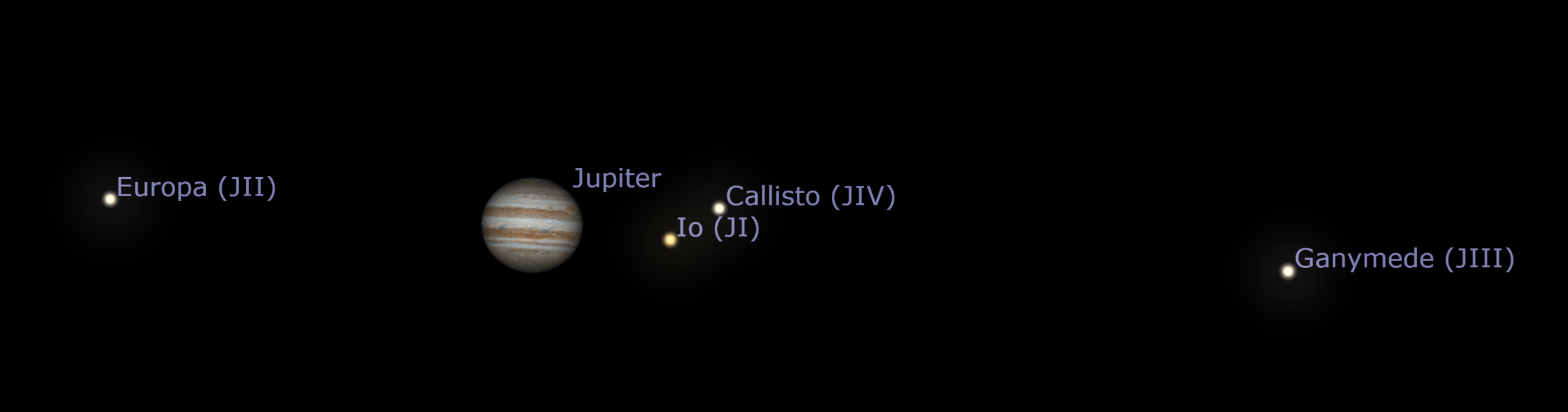
Image: Jupiter and the Galilean moons as they will appear on Jan 26. Credit: Stellarium
Scitech is a not-for-profit organisation proudly supported by the Western Australian Government through the Department of Energy and Economic Diversification




Upon clicking the "Book Now" or "Buy Gift Card" buttons a new window will open prompting contact information and payment details.